An oral irrigator (also called a dental water jet) is an electronic device that uses a stream of pressurised water to clean the spaces between teeth and below the gum line - areas a toothbrush cannot physically reach. Although it has been available on our market for years, only in the last decade has it become a standard part of modern oral hygiene - both for patients with healthy teeth and for those with implants, fixed bridges or periodontal issues. In this guide we explain how the device works, who it is particularly suited for, what features to look for when choosing one, and we recommend specific models from the B.Well Swiss brand - a company that has for years offered quality medical devices on the Serbian market with official distribution and service.
What an oral irrigator is and how it works
The principle is simple: a water reservoir (usually 150-300 ml), a pump that generates pressure, and a thin nozzle that directs the stream right between the teeth. The water jet mechanically rinses away food debris, plaque and bacteria from places a brush and floss cannot reach - between the teeth (interdental space), below the gum margin (gingival sulcus), and around implants, bridges and fixed orthodontic appliances.
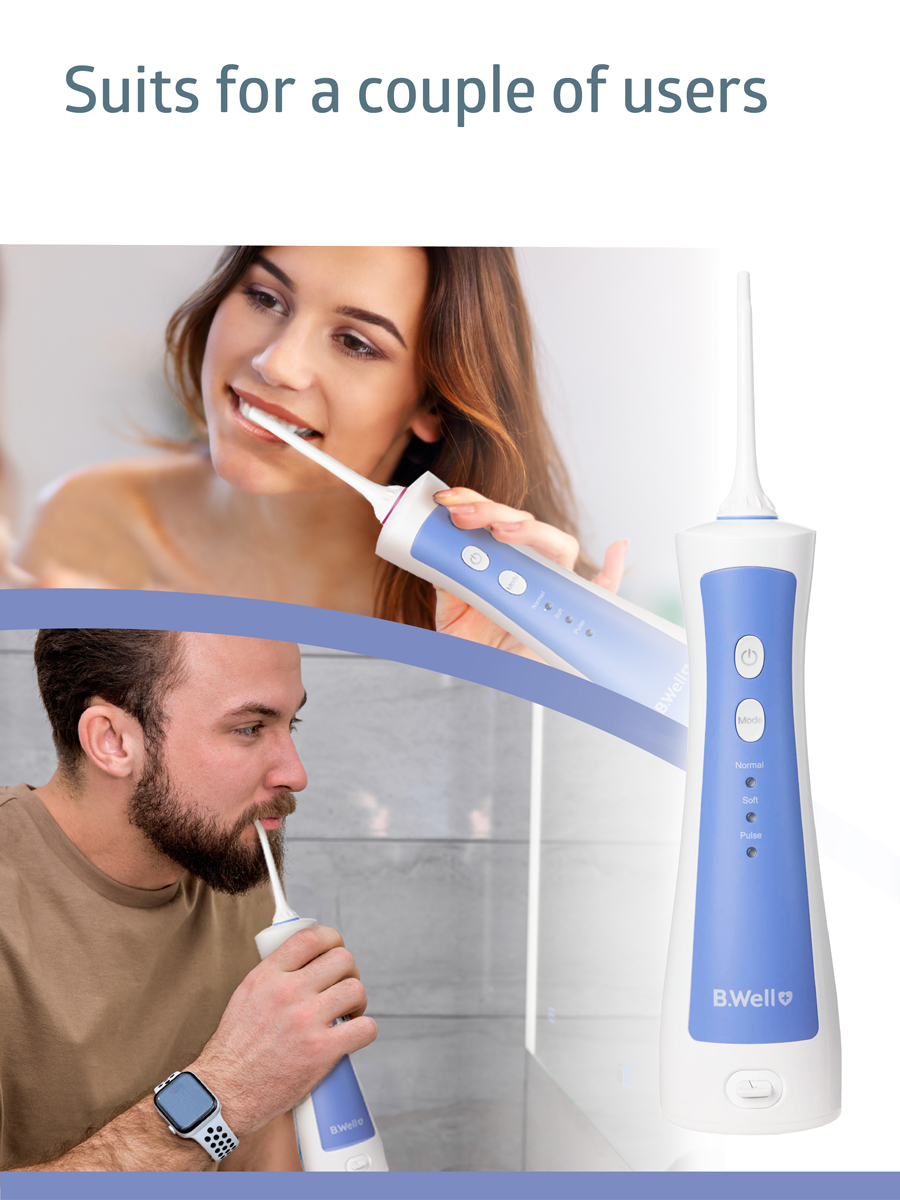
Quality oral irrigators operate at pressures from 200 to 700 kPa, with several modes: Normal (daily hygiene), Soft (sensitive gums and first days of use), and Pulse (gum massage and circulation stimulation). Models with multiple modes - such as the B.Well portable irrigators in the WI series - let you adjust intensity to the condition of your gums and your usage habits.
Why dentists increasingly recommend an oral irrigator
The classic "gold standard" of oral hygiene used to be: brush twice a day plus floss once a day. The problem with floss is that most patients don't use it properly - either too gently (ineffective) or too aggressively (injuring the gums). Studies consistently show that only 20-30% of patients floss daily, and an even smaller percentage flosses with correct technique.
The oral irrigator solves this practically - no one has to learn a technique. Put the nozzle next to the tooth, hold for a few seconds, move to the next. Technique is intuitive, use is consistent, and for most patients it is more effective long-term than sporadic flossing.
Oral irrigator vs floss - what research shows
A well-known 2017 meta-analysis (Cochrane Oral Health Group) showed that patients who use an oral irrigator have statistically significantly less gum bleeding compared with those using only a toothbrush - and the effect is visible after just two weeks of use.
Direct comparison of irrigator vs floss is less clear-cut - floss is slightly better at removing plaque from interdental surfaces, while the irrigator is significantly better at reducing gum inflammation and reaching subgingival (below the gum) zones.
The best combination for maximum effect: toothbrush + irrigator as the base, with floss added for patients with very tight interdental spaces or specific needs.
Who benefits most from an oral irrigator
While anyone can benefit, in certain patient categories an irrigator is not just a "nice extra" but practically a required part of hygiene:
- Patients with dental implants. Around implants, bacterial biofilm builds up very quickly, and brush and floss physically can't reach the junction between implant and gum. A controlled water jet is ideal.
- Patients with fixed bridges. A bridge has a "hollow" part underneath (between the abutment and the missing tooth) - that space can't be wiped with a brush, and threading floss through it requires super-floss. An irrigator is more efficient.
- Patients with fixed orthodontic appliances. Brackets and wires create extra spots where food gets stuck - an irrigator reaches them effortlessly.
- Patients with periodontal disease or gingivitis. Particularly useful as the jet cleans subgingival areas that are problematic in these patients.
- Older patients. Reduced hand dexterity makes flossing difficult - an irrigator doesn't require precision.
- Patients with xerostomia (dry mouth). The water jet additionally hydrates the tissue.
- Pregnant women. Hormonal changes amplify gum inflammation - an irrigator helps without harsh agents.
- Smokers. Extra stimulation of gum circulation, which is weakened by smoking.
Types of oral irrigators - portable vs countertop
Two main categories:
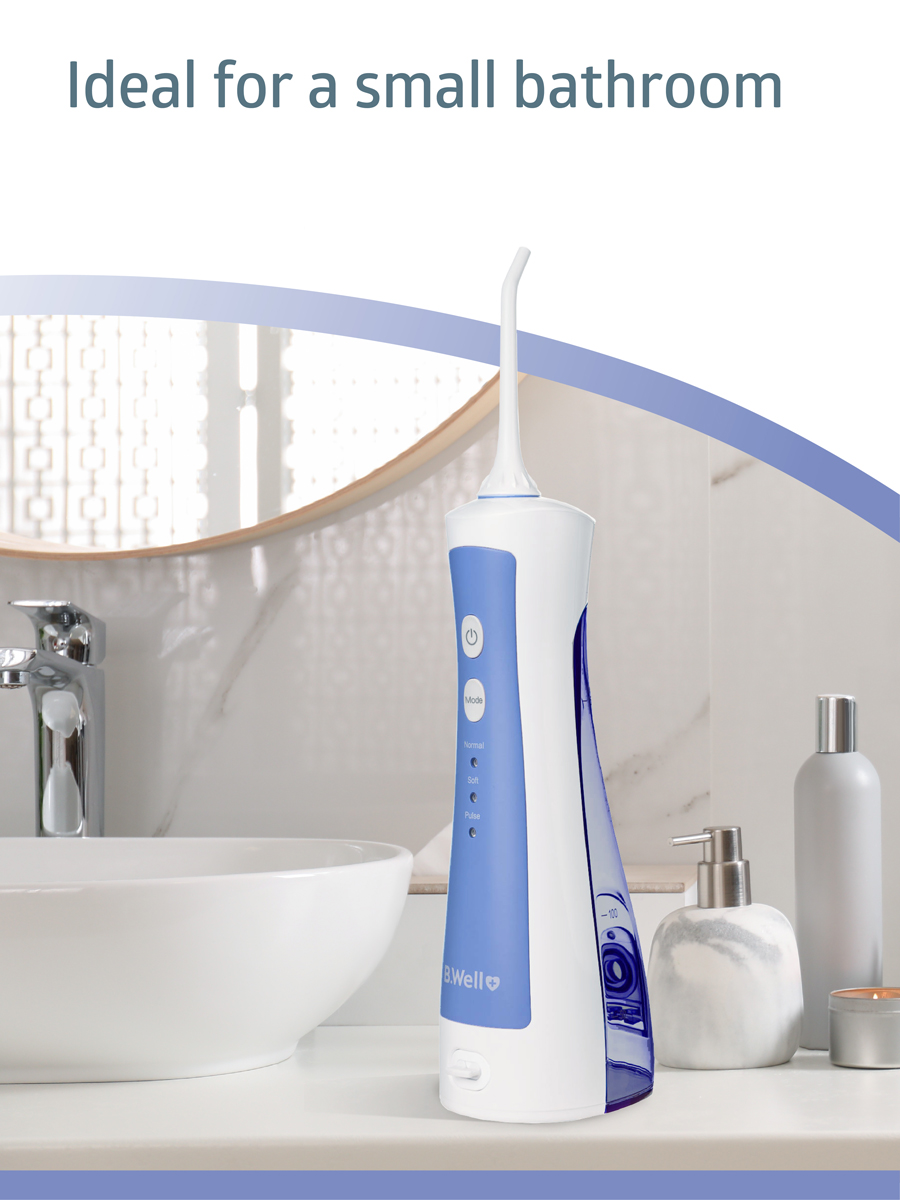
Portable (compact) models. Smaller, cordless, with built-in battery. Smaller reservoir (150-200 ml) but more convenient for travel and don't take space in the bathroom. Ideal for small bathrooms and patients who travel often. B.Well WI-911 and WI-922 are exactly that - compact portable irrigators with 620 kPa pressure (matching countertop models) and battery life of up to 30 days for couple use.
Countertop models. Larger, with power cord and bigger reservoir (500-1000 ml). Higher pressure and longer sessions. Suited to families with several daily users, but require a permanent spot in the bathroom near a socket.
For most patients with a standard hygiene routine - a portable model is sufficient and more practical.
Key features to watch for
When choosing an irrigator, a few things make the difference between an average and an excellent device:
- Pressure (kPa). Minimum 400 kPa for effective hygiene. Premium devices reach 620-700 kPa. Too little = ineffective; too much without adjustability = gum trauma.
- Multiple modes (Normal/Soft/Pulse). Soft for the first weeks while gums adapt, Normal for routine, Pulse for massage - all three modes give flexibility. All B.Well models include these three modes.
- Pulse frequency. Better devices run 1,200-1,700 pulses per minute - the optimal range for gum massage.
- Reservoir capacity. 150 ml is minimum (about 30 seconds of operation). 200 ml is comfortable for a full round (2 minutes for both arches).
- Battery life (portable models). Ideally 30 days without recharging for a single user, 15 days for two.
- Nozzle rotation. 360° rotation eases access to hard-to-reach areas (back molars, lingual surfaces).
- Water resistance. IPX7 certification means it can be rinsed under running water - important safety feature.
- Nozzle quality and number included. More nozzles (4-7) at the same price = each family member has their own.
- Warranty and service. Most important - a device that can't be repaired or replaced is just expensive consumable. Brands with official Serbian distribution (like B.Well Swiss) have official service and easier warranty.
How to use an oral irrigator properly - step by step
The technique is simple but a few rules make the difference:
1. Prepare the device. Fill the reservoir with lukewarm water (not cold - less uncomfortable for teeth, not hot - could damage the pump). Optionally add a few drops of chlorhexidine solution or antibacterial additive (periodically, not daily).
2. Place the nozzle in your mouth before turning it on. Without this you'll spray the whole bathroom. Lean over the sink and close your lips lightly around the nozzle.
3. Start at the lowest pressure. Especially the first 5-7 days while gums adapt. Gradually increase.
4. Move the nozzle along each tooth. The rule: 2-3 seconds per tooth on the outer (vestibular) surface, 2-3 seconds on the inner (lingual/palatal). Aim the jet at 90° into the space between teeth or at the gum margin.
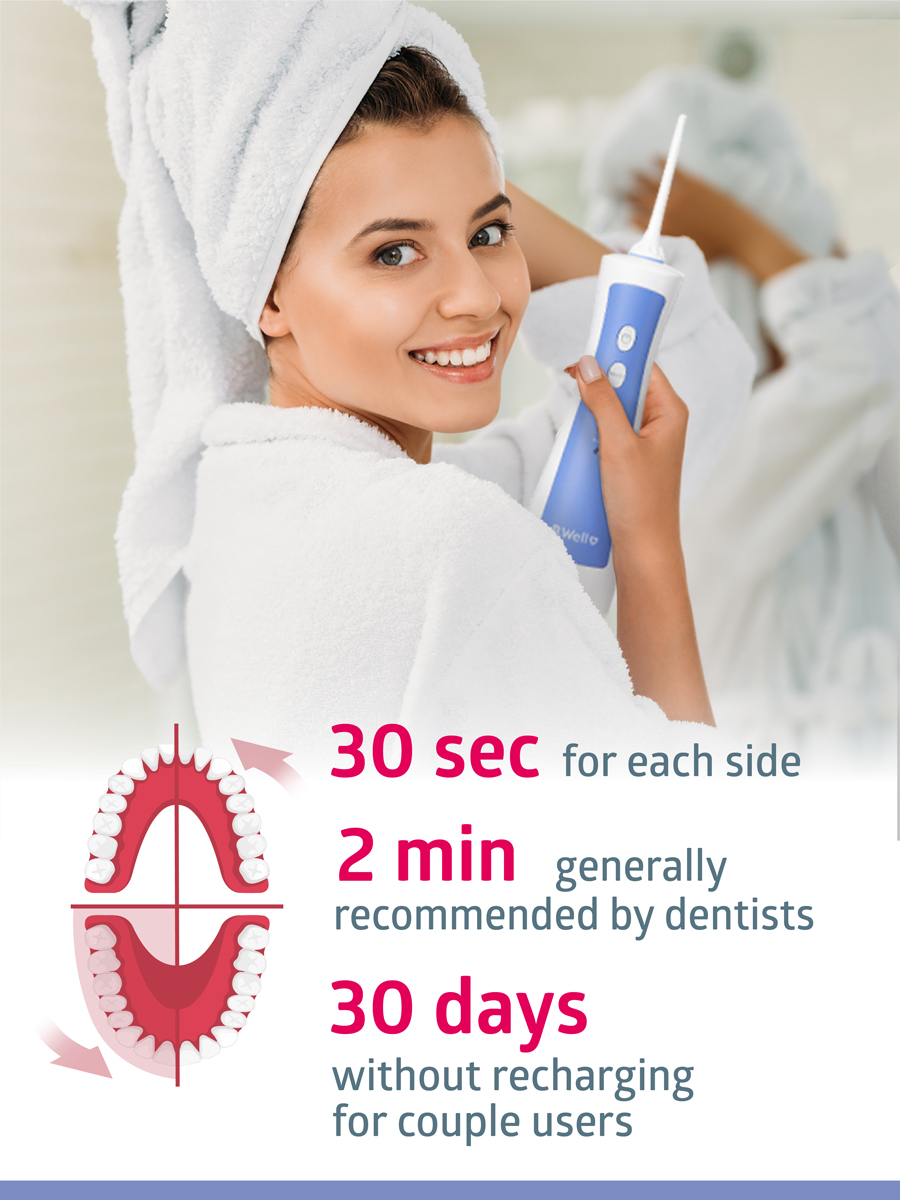
5. Session duration: 1-2 minutes total. 30 seconds per jaw quadrant (upper right, upper left, lower right, lower left). That's exactly the breakdown shown in manufacturer infographics - 30 sec for each side, 2 min total.
6. Let water flow out freely. Don't swallow - let it drain naturally from mouth to sink.
7. After use. Rinse the nozzle under running water, dry the reservoir (prevents bacterial growth and odour), clean the device weekly with a soft cloth.
Ideal frequency: once daily, ideally in the evening after brushing, before bed.
Our recommendation: B.Well Swiss
In our clinic we have for years recommended B.Well Swiss oral irrigators for several clear reasons:
- Certification. B.Well Swiss AG is certified to the international standard ISO 13485:2016 for medical devices, which guarantees quality and traceability in manufacturing.
- Official Serbian distribution. Warranty and service locally - no shipping abroad if something breaks.
- Three product lines (B.Well MED, PRO and TECHNO lines) cover different needs - from family use to professional care.
- 620 kPa pressure on portable models is on par with the best countertop devices - full effectiveness without giving up portability.
- Battery up to 30 days without recharging for a single user - excellent for travel and everyday comfort.
- Reasonable price. No "premium" marketing markups - solid quality at an accessible price.
Specific models we recommend most often:
- B.Well WI-911 - portable oral irrigator, ideal for an individual or a couple. Three modes (Normal/Soft/Pulse), 620 kPa, 360° nozzle rotation.
- B.Well WI-922 - similar to WI-911 but with a larger reservoir and additional nozzles in the kit - suitable for small families.
- B.Well TH-912 - a countertop model with the highest pressure, for patients with periodontal issues or multiple implants requiring thorough care.
You can see details and technical specifications of all models directly on the official B.Well irrigator category page.
A guide by user profile
Not every model fits every patient. Our recommendation by user type:
A young person with no dental issues who travels frequently. Portable model with battery (e.g. WI-911). Key feature: portability and battery life.
A couple sharing a bathroom, both with healthy teeth. Portable model with a double set of nozzles (e.g. WI-922). Each partner has their own nozzle - the intimate part of the device is not shared.
Patient with implants or major prosthetic work. Countertop model with higher pressure (e.g. TH-912) - more thorough daily care needed.
Older patient with reduced motor function. Countertop model with fixed placement - no need to hold and charge daily, just turn it on.
Family of 3-5 members. Countertop model with at least 5 nozzles in the kit - each member theirs, kept in a shared holder.
Mistakes to avoid
A few typical mistakes we see in practice:
- Using maximum pressure from day one. Gums need 1-2 weeks to adapt. Start on Soft mode.
- Direct jet on the gum margin at an angle. The jet should be aimed exactly into the space between teeth, not "cut" into the gum at a sharp angle - that can injure the gingiva.
- Aiming the jet deep into a periodontal pocket. In advanced periodontitis with deep pockets - use only Soft mode, jet parallel to the tooth axis, never force water deep below the gum.
- Using the irrigator as a substitute for brushing. It isn't a substitute - it's a complement. The brush still removes plaque from tooth surfaces.
- Not cleaning the reservoir. Moist environment = bacterial growth. Dry the reservoir after every use.
- Cold water. Lukewarm is more pleasant for teeth. Cold can cause hypersensitivity, especially in patients with exposed tooth necks.
- Using it only sporadically ("when I remember"). The effect comes from daily routine. Occasional use doesn't deliver the same benefit.
Device hygiene
An irrigator is a medical device that contacts the mouth - maintaining its hygiene matters:
- After every use empty the reservoir and leave it open to dry
- Once a week: fill the reservoir with a mixture of water and white vinegar (1:1) and run the device through - removes mineral deposits
- Replace the nozzle every 3-6 months (similar to a toothbrush)
- Clean the device exterior with a soft cloth - no harsh chemicals
Cost and what to expect from the investment
Prices of quality oral irrigators in Serbia are reasonably tiered:
- Portable models from quality brands: RSD 5,000-12,000 (B.Well WI series falls in this range)
- Countertop models: RSD 8,000-18,000
- Premium models with Bluetooth and app: RSD 18,000-30,000 (worth asking whether those features matter for you)
The lifespan of a quality device is 3-7 years. Spread across that period, an irrigator is one of the cheapest dental investments per day - less than RSD 1 per day for a device that directly reduces the risk of gum bleeding, periodontitis and implant complications.
Myths and misconceptions about oral irrigators
"An irrigator replaces brushing." No. The brush mechanically removes plaque from tooth surfaces. The irrigator reaches the areas between teeth and below the gum. Two devices, two different jobs. Used together.
"A pressurised water jet damages the gums." No - when used correctly, with appropriate pressure. Soft mode for sensitive patients, Normal for others. Proper use is 100% safe.
"Expensive models are far better than cheaper ones." The gap between the mid range (B.Well WI series) and premium is marginal for most patients. Expensive models often add marketing features (Bluetooth, app) that don't change cleaning effectiveness.
"I can use it if I have braces." Yes - it's recommended. An irrigator is in fact ideal for patients with orthodontic appliances.
"Children shouldn't be taught to use an irrigator." On the contrary - from age 8-10 children can use it under parental supervision on Soft mode. It's easier than floss because it's more intuitive.
"Once a week is enough." No - the effect comes from daily routine. Once a week is better than nothing, but far from optimal.
Who an oral irrigator is NOT the first choice for
Though very useful, there are rare situations where it isn't the right tool:
- Patients with an acute gum abscess. Wait for the inflammation to subside, then introduce.
- Acute gingival ulceration (necrotising inflammation). Treat the ulceration first.
- After surgical intervention. 7-14 day pause, until the wound heals.
- Children under 6. Mechanics too strong for unfinished baby and young permanent dentition.
- Patients with heart conditions at risk for bacterial endocarditis. Discuss with your dentist - the water jet can temporarily push bacteria into the bloodstream through open spots on the gums.
In all other cases - the irrigator is an excellent complement.
Conclusion - is the investment worth it
The oral irrigator is one of the rare home medical devices where the cost-to-effect ratio works extremely well. For an investment of RSD 5,000-12,000 you get a device that, over years, directly reduces the risk of gum bleeding, periodontitis and complications around implants - with minimal time spent (2 minutes per day).
Our recommendation is clear: if you have implants, bridges, fixed orthodontic appliances or a tendency to gum problems - an irrigator is a required part of hygiene, not an extra. If you have none of those - it's still an excellent habit that extends the lifespan of your teeth.
In our clinic we always recommend proven brands with local distribution and service. B.Well Swiss is such a brand - Swiss quality, Serbian distribution, local warranty, reasonable prices.
If you're considering a purchase and aren't sure which model best fits your profile - feel free to ask at your next consultation. We chose these brands because after years of clinical practice we keep coming back to the same ones - because they work.